FIFA WC26: The hottest World Cup ad might be in your fridge
From Heinz's Penalty Packets to Coca-Cola's collectible cans, brands are using packaging to win fans' attention
 by
by
Published: Jul 11, 2026 9:06 AM | 6 min read
 Follow Us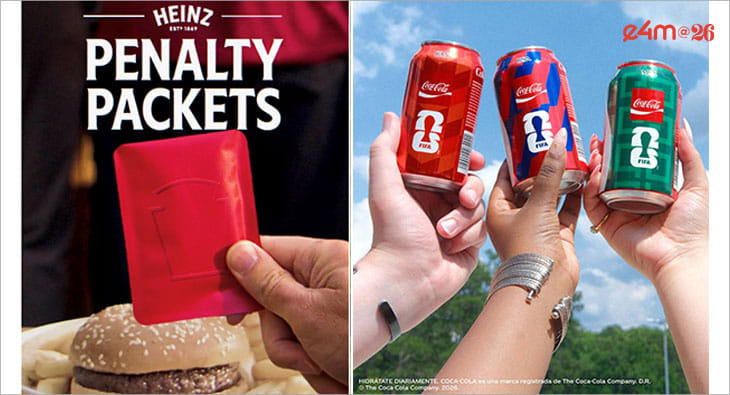

- The FIFA World Cup 2026 is expected to see over $10 billion in global advertising and marketing spend, highlighting the event's significance as a marketing platform.
- Brands are increasingly using packaging as a strategic tool for storytelling and consumer engagement, moving beyond traditional sponsorships to create impactful campaigns.
- Heinz's "Penalty Packets" and Coca-Cola's country-specific collectible cans exemplify how brands are creatively integrating their products into the World Cup conversation without relying solely on sponsorship rights.
- The trend reflects a shift in marketing strategies, where packaging serves as a starting point for campaigns, enhancing consumer experience and engagement in a fragmented media landscape.
Every 4 years, the FIFA World Cup becomes marketing's biggest playground. And every 4 years, brands rediscover the same lesson: you do not need a sponsorship badge to own a piece of the conversation; you need an idea strong enough to travel on its own.
The FIFA World Cup 2026, spread across 48 teams, 104 matches and three host nations for the first time, is proving to be the most expensive proof of that lesson yet. Industry estimates peg global advertising and marketing spend linked to the tournament at more than $10 billion. Yet the most interesting story emerging from this year's competition is not about who bought the largest billboard or the most expensive broadcast inventory. It is about how brands are increasingly turning packaging itself into a campaign platform.
For decades, special-edition packs were little more than commemorative add-ons. Today, they have become strategic tools for storytelling, collectability, fan engagement and even cultural relevance. Whether official sponsors or ambitious outsiders, brands are discovering that the package in a consumer's hand can be just as powerful as a television commercial.
Read On: How FIFA’s branding rules created an unexpected marketing moment
Heinz offers perhaps the clearest example of this shift. The ketchup giant is not an official FIFA partner, yet its recently launched "Penalty Packets" have managed to insert themselves into World Cup conversations without spending a dollar on sponsorship rights. The idea is deceptively simple. Football's iconic red and yellow cards resemble Heinz's ketchup and mustard sachets in both colour and shape. Rather than ignore the similarity, Heinz built an entire campaign around it.
The special-edition packets contain twice the amount of sauce found in a standard serving, addressing what the brand describes as a universal fan truth: one packet is rarely enough.
When FIFA's clean stadium regulations forced Heinz branding to be covered inside non-sponsor venues, the company transformed the situation into social content celebrating its role as the "unofficial stadium ketchup." Sold exclusively through Walmart for $1.57 per box (a nod to Heinz's famous "57 varieties" heritage) the packets have found additional relevance thanks to the tournament itself. With the World Cup already witnessing an unusually high number of red cards, the metaphor has arguably become even more visible than the brand could have anticipated.
While Heinz demonstrates how non-sponsors can creatively enter the conversation, Coca-Cola shows how official partners are taking packaging far beyond traditional branding exercises. Football's longest-running sponsor, associated with FIFA since 1978, has built an extensive packaging-led ecosystem around the tournament. Working with creative agency GOLDEN, Coca-Cola introduced a global visual identity centred around its "Arden Square" design framework and football-inspired graphic elements. The result is a collection of country-specific cans that celebrate competing nations while remaining visually connected as part of a larger set.
View this post on Instagram
Argentina's can design features diagonal stripes inspired by the national jersey. Mexico's edition incorporates green crosshatched patterns. Across all markets, trophy symbols and country identifiers are placed consistently, reinforcing the idea that consumers are collecting members of the same global squad.
Read On: As FIFA fever builds, brands are turning fans into communities
The programme extends well beyond aesthetics. Coca-Cola has partnered with Panini, integrating collectible football stickers beneath bottle labels and creating an additional layer of fan engagement. Millions of promotional bottles have already entered retail circulation across multiple markets, transforming ordinary purchases into opportunities for collection and discovery.
Of course, football-themed packaging is hardly new. Brands have long used the World Cup as an occasion for limited-edition designs. Collectors still seek out memorabilia from France '98, while tournaments such as Russia 2018 generated their own wave of commemorative products.
What has changed is the sophistication of the approach. Today's World Cup packaging strategies rarely operate in isolation. Instead, they are connected to digital experiences, loyalty programmes, creator partnerships, QR-enabled content and social media engagement. The package is no longer the final touchpoint in a campaign; it is often the starting point.
Budweiser, celebrating four decades as an official World Cup sponsor, has introduced an 11-bottle anniversary collection that commemorates every tournament since Mexico 1986. Each bottle links consumers to archival content through QR technology, turning nostalgia into an interactive experience.
View this post on Instagram
PepsiCo has reportedly produced tens of millions of football-themed cans globally, including a limited run of thermochromic variants that change colour at an optimal drinking temperature. Lay's continues to activate its "No Lay's, No Game" platform as the tournament's official snack sponsor. Michelob Ultra has introduced football-inspired packaging linked to US Soccer, while brands outside traditional food and beverage categories are also joining the movement.
The underlying reason is simple. The World Cup has evolved into far more than a sporting competition. According to YouGov research, consumers across several markets tend to view tournament sponsors more favourably during the World Cup period. That cultural reach is precisely what makes packaging such an effective medium. Unlike a television commercial that disappears after 30 seconds, a collectible can, bottle or packet lives on in kitchens, offices, social media posts and fan collections long after the final whistle.
Read On: FIFA World Cup 2026: What's drawing Indian brands beyond the pitch?
For India, the trend carries particular significance. Despite never having qualified for a FIFA World Cup, India continues to represent a meaningful commercial opportunity for brands looking to tap into football fandom. Zee Entertainment, which holds FIFA media rights in India through 2034, has already attracted a significant roster of advertisers around the tournament. Meanwhile, Coca-Cola has launched India-specific initiatives such as Matchday Hangout, a creator-led live watch format featuring personalities including Rohan Joshi and Sakshi Shivdasani, integrated with purchases on quick-commerce platforms such as Zepto and Blinkit.
That gap creates room for inventive marketers. Whether it is Heinz's cleverly disguised football cards or Coca-Cola's collectible nation-themed cans, the most successful World Cup campaigns increasingly share a common characteristic: they place the experience directly into consumers' hands.
View this post on Instagram
As brands compete for attention in an increasingly fragmented media environment, packaging is evolving from a functional necessity into a strategic creative canvas. FIFA World Cup 2026 may be remembered for its expanded format and record-breaking scale, but from a marketing perspective, it may also be remembered as the tournament where brands fully embraced the idea that sometimes the campaign is not about the product. Sometimes, the product is the campaign.
Read more news about Marketing News, Advertising News, PR and Corporate Communication News, Digital News, People Movement News
For more updates, be socially connected with us onInstagram, LinkedIn, Twitter, Facebook, YouTube & Google News